Showing posts with label Costa Rica. Show all posts

Tuesday, March 1, 2011

Costa Rica Wrap-Up & Plans For March!

February was so short!!!! Well....since I gave up coffee for the month, the mornings of February did tend to ddrrrrraaaaaagggggggg, but overall, it went by so fast!


I enjoyed my pleasant day-dream vacation in Costa Rica this month. I can honestly say I've thought about living in a treehouse every day since my blog about Finca Bellevista, and even the crazy bright colored bugs have grown on me as I've looked at more and more pictures. Costa Rica's "pura vida" lifestyle is pretty enticing and I very much hope to visit one day.  I definitely want to take a zip-line tour over the canopy of one of the cloud forests, and I'd love to see how my attempt at gallo pinto stacks up...and maybe to take a cooking class:)

Studying Costa Rica was definitely a departure from my time with the Congo, and I must admit I had a form of culture shock switching out of thinking about some of the heavier subject matters discussed in my January blogs.  Life in the Congo is so different from my lifestyle, which made studying their customs and way of life fascinating. At the same time, I felt a lot of sadness for the unfortunate and, at times, unconscionable situations that many Congolese people face. To switch from reading current news stories about rape being used as a weapon of war in the Congo to seeing headlines about Costa Rica as a leader in environmental policy and being a top tourist destination was about as drastic a change as possible.

It was really heartening to learn about the "Switzerland of Central America" (they abolished their military in 1949!) and to marvel at the beauty of their well-preserved ecosystems.  I felt inspired to take a second look at the land on which I live - I've tried to more appreciate the plants and creatures around me (even the darn green parrots that hang out in a tree on my street and squawk up a storm).  I also really really loved the gallo pinto I made on feast night and the Lizano sauce I bought - I will absolutely continue enjoying Costa Rican food!!!!

All in all - I had a great month immersing myself in Costa Rica!

Soooooo, are you ready to hear where I'm armchair traveling to this month????.........Korea!!!!!!!


Sunday, February 27, 2011

Costa Rican feast!

After the relative success of my Congo feast night last month (fufu - never again!), I decided to have  Costa Rica feast night!!! My cousins were the brave taste testers, and Kevin cooked up some meat again!

In Costa Rica they often call a complete meal a casado, which literally translated means "married," and reflects the blending of various foods to create a full and satisfying meal. There is always gallo pinto (rice and beans mixed together) which is a huge staple in the area, as well as some fried plantains, meat, and maybe tortillas and a salad. Here's my attempt!!!!

I made ceviche as an appetizer - Brandon approved:)


I also made up some empanada type appetizers with a gallo pinto and egg stuffing (confession - I used pre-made empanada dough...sooooo delicious!)  In Costa Rica the most popular condiment is Salsa Lizano. I went to a Latin market here in SD and the guy working there told me that the salsa you see in the bottle in the picture above is basically the same thing. I LOOOOOOVED it - tangy and sweet. Not Ashley's favorite though....

Yummy Costa Rican beer - "Imperial"

I bought some pre-made tostones (fried plantains) and fried them up...but none of us really liked them as you can probably tell from Ashley's expression. I've got some intrepid cousins:)

Here's my plate (top) and Kevin's (bottom). On my plate you'll see one of the gallo pinto empanadas, to its right is a salad made from hearts of palm, then the components of gallo pinto - beans and rice cooked with onions, red pepper, oil and cilantro -  YUMMMMM. On Kevin's plate is a pork dish he made. 

In a previous blog I mentioned the Costa Rican coffee I bought online from Cafe Milagro...oh man, it is delicious!!! I also attempted to make a tres leches cake. Don't be fooled by how it looks in the picture...it ended up basically inedible. I am ABSOLUTELY not a baker!!!

My favorite part of the meal was probably the gallo pinto empanadas with lizano sauce. SSOOOO yummy! I'm gonna keep buying that sauce forever!

Another successful evening of international dining! It had its good and bad points, but overall, a fun time had by all!

Wednesday, February 23, 2011

Costa Rica in the early years

The best way for me to connect with ancient cultures is to examine their art...so I hope you join me on my little journey through time:)


Much of Costa Rica's pre-Columbian art was functional. This stone metate (used to grind grain into flour), features an animalistic qualities. I like the parrot-like head - he seems so happy! It reminds me of the birds in the Tiki Room in Disneyland.  Anyways, this guy is 2500 years old, give or take, is made of volcanic rock, and is about 30" in length and stands roughly 15" high. I bet he's borne a TON of pressure over time - grinding grain is tough work...I think I'll pass on grinding my own flour this way for Costa Rica dinner night recipes...


 Costa Rica's natural deposits of gold and copper made way for early artisans to refine their metalworking techniques. They obtained the gold through panning-type means - washing river silt in wood trays. Early artisans would hammer small fragments of gold into decorative chest plates, bracelets, hair bands and discs which were decorated with geometric designs, animal forms, and representations of humans. They created the designs using a technique called repoussé. which involves pressing on the back part of the object with a dull instrument to create the raised design on the front.  


For figurines and adornments, early artisans would use the lost-wax method of production - first molding the figure in beeswax, then covering the beeswax object with several layers of clay, which would then dry over the course of a few days. The mold would then be heated and the wax would melt and drain out of the hardened clay, leaving an hollow space in the form of the desired object. Molten metal would then be poured into the hollow space, the mold would cool, and the clay would be broken off. After a little cleaning, touch ups, and polishing, the process would be complete.

The figurine above represents a shaman dressed in costume - so a man-animal hybrid figurine, which is quite common. The mask the shaman is wearing has crocodile characteristics, and the shaman is also shown in a costume comprising a breastplate, woven belt, and elaborate headdress. PG-13 component -  It's hard to see in this tiny picture, but if you zoom in on his...um...private area...you might notice that a snake head shape has been substituted for what you'd assume would naturally be there:) Although the source I read said snakes were fertility symbols, I'm thinking this guy didn't pick up too many of the hotties in his tribe.....


There are numerous ceramic objects that have been found in Costa Rica - vessels, figurines, etc., however their seals and stamps are perhaps the least known and studied. They come in a variety of sizes and shapes - sometimes cylindrical, sometimes flat, and often featuring geometric shapes such as triangles, diamonds, circles, spirals, concentric figures, etc. They can also feature the human figure and animal forms.

Pre-Columbian tradition involved the use of graphic elements to communicate symbolic meaning often related to ritual practices. These patterns were often used in body decoration  as well as to create patterns on textiles.

Friday, February 18, 2011

Costa Rican Treehouse Community!!!!

So, I am a huge disney fan, and I often daydream about where I would live in Disneyland if ever given the option, and I've always thought it would be ideal to live in the Swiss Family Treehouse (yah, I know it's Tarzan themed now, but I like to think if I had the power to live in Disneyland I could also have the power to time travel to back before disney defiled the treehouse with the Tarzan theme). But anyways.........getting back to the main point of this blog...I discovered a treehouse community developing in Costa Rica!


Inspired by the Ewok village in Star Wars, a young couple have begun creating what is being billed as the first planned, modern, sustainable treehouse community called Finca Bellevista. The location is unbelievable- close to beaches, national parks, hiking trails and whitewater rivers.  They began construction about three years ago, but are still in the early stages of development with about 5 houses completed, as well as a community center and other support structures.  Although most owners are using their treehouses as rentals, the developers of the community are hoping that more full time residents will move in - they even point out that one resident telecommutes from his bungalow by using 3G cell and internet service.


It seems like an expat's paradise at the moment - ownership at the moment is 60% american, 35% Canadian, and 5% European. Hmmmm, I always thought I was in San Diego to stay, but I might have to start thinking about a treehouse retirement plan:)


Wednesday, February 9, 2011

Coffee in Costa Rica

So, this month happens to be my annual detox month - I eat mostly fruit, veggies, whole grains like quinoa and wheatberries, some fish, some soy, and that's about it... no bread, no processed or refined foods, no caffeine. I had a headache the first three days because I'm SO addicted to coffee. So in starting to write this blog I'm pretty scared that it's going to send me spiraling. Especially since I am writing this from a coffeeshop - my mug of green tea is just...delicious.....:(


Coffee isn't indigenous to Costa Rica - it actually didn't arrive until the last decade of the 18th century. Although the spread of coffee cultivation moved slowly through the country, it eventually became a main export, and was transported around the country using the railroad (you guessed it - the railroad built by Henry Meiggs and Minor Keith for the United Food Corp!). The country has now become so connected with the exportation of coffee that the Costa Rican tax year is based on the coffee trade, beginning in October and ending in September of the following year. The most famous coffee-producing regions are Tarrazu, Tres Rios, Heredia, and Alajuela. From what I've read, coffee is widely esteemed in Costa Rica, and enjoyed by almost everybody. In fact, the government decreed in 1840 that all laborers building roads should receive a free cup every day! However, in reading some articles about coffee in Costa Rica, I was surprised to hear some complaints about the coffee in the country. Supposedly much of the best coffee is exported, leaving locals with the dregs:(


A Guaymi woman hand picking coffee

Much of the coffee in Costa Rica is picked by local laborers. In some regions particular indigenous groups act as migrant workers, some of which cross the border for work, such as the Guaymi who come from Panama. They can be recognized by the women's brightly colored dresses, bags made from plant fibers, and beaded bracelets and necklaces.

Cafe Milagro

So, in the midst of reading for this blog I got caught up in a website for a company (Cafe Milagro) created by a couple who traveled to Costa Rica a few summers in the early 90s and fell in love with the country. They ended up buying a coffee roaster and opening up a warehouse where they started a coffee roasting business. Sometimes customers would come in to buy a kilo of coffee and would relax on a sack of beans while they enjoyed a cup of fresh roasted coffee. They ended up being so popular that the created a little shop and a local baker supplied pastries, and eventually began serving dinner.


Not only have they created a successful business in the coastal town of Quepos, they also donate a portion of their profits - some to the chamber of commerce, some to the Titi Conservation Alliance, which protects local biodiversity, and they also have a yearly fundraiser to raise supplies for a local area school. If you are interested in ordering some of their coffee, check out their website. I just ordered their Organic Dark Roast - grown in high altitude volcanic soil and handpicked by independent family farmers. I also got the shade-grown, pesticide-free Finca Rosa Blanca Eco Estate Coffee, which cultivates trees in a way to create a biological corridor for birds and mammals in the area. They gave me some free chocolate covered pineapple with the order. MMMM, I can't wait to break my detox on my Costa Rican cooking night with a steaming cup of coffee and a chocolaty treat straight from a beach town in Costa Rica!!!!

If my post here really resonated with you and you'd like to move to Costa Rica and get involved with the coffee business, maybe you should consider buying this Costa Rican Coffee Farm - only $80,000!

Monday, February 7, 2011

Costa Rica - the original Banana Republic?

Banana and Papaya bread, fried bananas with cinnamon sugar, tamales cooked in banana leaves....these are all recipes I came across so far in my inquiry into Costa Rican delicacies (oh yes, there will definitely be a Costa Rican cooking night - I'll upload pix and share recipes).

No - I did not make this.....but hopefully what I make will look as delicious
(minus the meat!)

I've always thought about bananas as being a huge part of Central American cuisine, but when I looked into them a bit (after the suggestion and article from Anne -thanks!!) I was surprised to discover that bananas aren't native to Central America. They were actually first documented and domesticated in Southeast Asia and in some parts of Africa. Portuguese sailors introduced them to the Americas in the 16th century, however they mainly were just eaten by locals at that point.

In 1871, a US railroad entrepreneur, Henry Meiggs, signed a contract with the government of Costa Rica to build a railroad connecting San Jose to the port of Limon in the Caribbean. His nephew, Minor Keith assisted in the project and took over after Meigg's death.
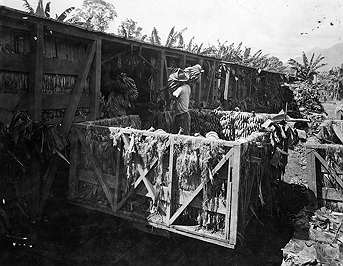
The building of the railroad through the dense, mountainous jungle allegedly claimed the lives of over 5000 workers, including Minor Keith's three brothers. Undaunted, Keith continued his work in Costa Rica, and also came up with the idea of planting bananas along the train route to use as a cheap food for his workers. The bananas flourished, and he ended up exporting them to the US...while paying exteremly low wages to his workers.

banana harvesting

Keith went on to establish plantations in Panama and Columbia and came to dominate the banana trade in Central America. His company eventually merged with another to become the United Fruit Company (UFCO), of which he was the vice-president. UFCO controlled more than 75% of the US market by the end of the 19th century.

train being loaded with bananas

A major monopoly, UFCO flourished in the early and mid 20th century, exporting from Central America, the West Indies, and the Caribbean coast of South America. UFCO was frequently accused of bribing government officials in exchange for preferential treatment, exploiting workers, paying little in the way of taxes to the governments of the countries in which it operated. The development of many of the countries in which the UFCO operated were greatly affected economically and politically by the involvement of the multinational corporation, which was nicknamed el pulpo, "the octopus," in reference to how the many arms of the company extended into the infrastructure of the country.

The UFCO also convinced the Costa Rican government that due to the threat of hurricanes, blight, and other natural threats that they needed reserve land, which prevented the government from distributing banana lands to local peasants who wanted to share in the lucrative banana business. Although it's easy to point a finger at UFCO, some of what they brought to Central America was positive in some ways - they built extensive railroads and ports, provided employment, created schools. However, in some places they discouraged the government from building highways as they would endanger the transportation monopoly UFCO had created.

A new face for the company

Although the UFCO had a lot of control over the dictators in many of the countries in which it operated, it had no control over WWII, which brought with it a huge slump in banana sales. Noting the success of Carmen Miranda at the time, the company created the character of Senorita Chiquita Banana. With a fruit strewn hat and a Latin dress, the banana shaped character danced her way into American households. Songs and jingles were written (with promotional copies of sheet music being sent to schools), her spunk and vibrancy was admired by American housewives, and US soldiers voted her the "woman" with whom they'd most want to share a foxhole.

Sheet music

However, after years of worker strikes, in 1958 labor reforms becan to take place, and the monopoly of UFCO was broken by an anti-trust suit. Some of their holdings were divested to Guatemalan companies. Undeterred by the anti-trust suit, the UFCO continued marketing itself to Americans in inventive ways during the 1960s - offering discount coupons and recipe books, creating catchy jingles, even hiring doctors to expound upon the health benefits of bananas.


The company was taken over by a corporate raider in the late 60s, who became the largest shareholder and eventually was overwhelmed by crippling debt and committed suicide by jumping out of his office on the 44th floor of the Pan Am Building in New York City. The company has merged and eventually became part of what is now Chiquita Brands International.

It's kinda crazy to think about how cheap bananas are here in the US, despite the fact that they are grown thousands of miles away, have a two week life span, and have to be transported in climate controlled containers. I read that American eat more bananas than apples and oranges combined - we are a HUGE market for them. I guess all that marketing after WWII really sunk into our national eating habits.

Well, in studying about the Congo last month, I learned a great deal about the devastating effects of colonialism. The UFCO has been accused of Neo-colonialism on the part of big business. I suppose every country I study will have a dark mark in it's history as the result of greed and the desire for power:(

Friday, February 4, 2011

Costa Rica's MYSTERY BALLS


In Costa Rica there are over 300 mysterious spherical stones like this of which nobody knows the exact origins. I, of course, think they came from aliens, however, some of the more common myths around their creation include that they came from Atlantis, or that they naturally occurred. There are also local legends saying that some native inhabitants had a potion to soften rock. They range in size from a few centimeters to about 6 feet in diameter, and some weigh tons! The date range for most of them doesn't really narrow their age very well - 200 BCE - 1500 CE.


The first time they were recorded is around 1930 when the United Fruit Company came across about a dozen when they were clearing the jungle for bananas (booo- they have been accused of bribing government officials, paying little taxes to the countries they exported from, exploiting workers, and trying to create a monopoly in most of the countries where they harvested). When they were originally found, they were often grouped in alignments that have been speculated to relate to the magnetic poles or astrological phenomena.

According to the little blurb I read, people like to find them and use them as lawn ornaments, which reminds me of my favorite pennsylvania lawn ornaments:

The way I remember Pennsylvania, there were three of these on every yard, but I might be exaggerating a bit:)

Blu in Costa Rica

One of my favorite street artists is an Italian muralist/animator who goes by Blu. I've known about him for a little while - he does these amazing wall animations where he'll paint something on a wall, take a picture, paint over it a bit, take a picture, repeat, repeat, sometimes move away from the wall and move objects around and move along the street - basically he makes stop motion animations out on the street. We had one of his videos in the recent Viva la Revolucion exhibition at MCASD.


I recently stumbled across a video where some people interested in his art followed him around for a while (back in 2006) as he traveled through Mexico, Guatemala, Nicaragua, Costa Rica, and Argentina to create a documentary of sorts. They ended up showing a lot of his process, however they also were really drawn to the people with which he interacted. Blu worked in a lot of areas that were pretty poor or had been hit badly by natural disasters or political instability, but he found great community leaders who used the arts to bring hope and beauty into people's lives, and he often collaborated with community art centers or local youth in villages as he worked on his projects. It's a great film and it's available in its entirety (just under an hour) at this link http://www.linktv.org/programs/megunica (sorry - I couldn't figure out how to embed the video). If you'd like to specifically see the part in Costa Rica, start around minute 37.

Blu's style is very much linked to drawing, even though he does primarily work with paint. There is a strong linear quality to his work, and he has a very particular style, dominated by slightly rotund and simplified male human forms that organically morph....it's hard to know exactly what he "means" by them, but I like one quote he says in the movie when a young man asks him about his intention:
Well it's not that everything must have a precise meaning - these are symbols that can also be used to say something, but normally drawing should be detached from meaning. People should decide themselves what they are about.
One of my favorite parts of the movie is towards the end, in Argentina, when the film crew spends a lot of time listening to people analyze Blu's work. Everyone has different ideas about what it means and one kid reads so much into the work - it's cool to see how Blu's work, by not having specific obvious meaning, draws the viewer in as they work their way through it. I hope that his work in every country sparked dialogue like what was shown towards the end of the video!

While in Costa Rica, Blu visited San Jose and worked with a group that provided opportunities for kids to create and express themselves. The leaders mentioned that 20 years ago Costa Rica was quite different, with really good public education. However, the leaders say that the focus has turned to creating more prisons and police forces. Blu talks to the kids about how he feels graffiti belongs on the streets and is a way for lots of people to begin creating art. He takes the kids out and they ask locals if they can cover up walls that are tagged and ugly with murals that they create as a group. The footage of Blu working with the kids is really cool - lots of high spirits, kids working with him, people coming out to watch, etc.

So, I was really impressed with this movie, and I hope you enjoy it! It's a bit of a tangent for my blog as it only partially relates, but I think it's an interesting reflection of life and opportunities for kids in some parts of Costa Rica.

Wednesday, February 2, 2011

Pura Vida in Costa Rica


I had no idea where to start on my exploration of Costa Rica, so I've just been doing some google searches, and I keep coming across the phrase Pura Vida. Literally translated it means "pure life" but the meaning is said to be more like "this is living" and "going great!" It's a phrase that can be used in tons of situations - greetings, to say thank you, to express satisfaction. It seems to sum up the sentiment of many Costa Ricans and their sunny outlook on life. Costa Ricans, known as ticos, are sometimes called the "happiest people on earth" ...probably because they live in such a beautiful place - check out some of the images in the youtube video below. Droooooool........I think I found my next vacation spot.


In trying to figure out what makes Costa Ricans tick, it seems that they are very interested in community, protecting the environment (the Costa Rican government even announced that they are trying to be the first carbon neutral country by 2021), enjoying life slowly, and celebrating good fortune.

Costa Rica has been categorized as a "Blue Zone" - a place where common healthy traits and life practices has resulted in longevity in residents, and a higher number of people that average live active lives past 100 (other blue zones include Sardinia, Italy; Okinawa, Japan; Loma Linda, California; and Icaria, Greece). Some of the traits that these groups share include strong family bonds, not smoking, plant-based diets with lots of legumes, constant moderate physical activity, and lots of social engagement.

Sooooo, so far Costa Rica seems pretty ideal. I'm sure I'll find some stuff out that scratches beneath the surface a bit, but I can already tell that researching this country will be quite different that learning about the Congo. I kinda miss reading about the Congo...it's hard to switch over:( I'm sure I'll find lots to love about Costa Rica though...I already REALLY want to go there. Except I hear they have lots of bugs....yikes.