Man, oh man, after this 4 minute clip I am completely convinced that I need to see this entire movie:) My favorite Indian composing duo, Shankar Jaikishan? Check. Synchronized Swimming? Check. 1960s awesomeness? Check. Guy looking pissed off with a pencil thin moustache? Check. what more could you want?
Thursday, August 25, 2011


Wednesday, August 24, 2011
Indian Hair - it's everywhere!
I just watched the documentary "Good Hair" last night, where Chris Rock goes on a quest to learn more about the lengths black women will go to (and some men) to get "relaxed" hair. Oh man, it was enlightening. I cannot believe the pain and inconvenience they go through...and the expense! Holy cow! thousandssssssssss of dollars. I'm done complaning about my hair that started going gray when I was 13....NBD, color it once a month and I'm good to go - NOTHING compared to sitting in a chair for hours while chemicals eat away my scalp or my hair is pulled tight into braids that then have hair sewn to them, and not being able to get my hair wet EVER. Wow.
So, anyways, you might be asking how this relates to armchair travels in India. Turns out, some of the most prized hair for weaves comes from India. Sometimes this hair is called "temple hair" because it is often procured when donors shave their hair as part of a ritual offering to the gods....which then fuels a multi-billion dollar industry. The hair used to be used as mattress stuffing, but now temples have contracts with particular companies and the money is supposed to go to the poor and to pilgrims, but there is little documentation of the proper usage of the money.
 |
| A woman sacrificing her hair (tonsuring). |
Most of the work in the factories is done by hand - sorting, washing. The long lengths are the most valuable and journey west - destined for high fashion and glamour. The orders keep coming in the and the industry is booming.
 |
| An Indian hair factory worker sorting through many people's sacrificed hair. |
 |
| Final product |
I've heard some people talk about getting transplants of body parts who think a lot about the person who donated their heart/kidney/liver, etc. I know that's a different situation as it is a life-giving sacrifice, but I wonder if many people who use Indian hair sometimes think about the women who gave their hair...think about their lives, recognize where their hair comes from, feel a kinship of sorts with women on the other side of the globe...
Here's a documentary that explains the industry step-by-step.
Wednesday, August 17, 2011
The dying "art" of snake charming - a good thing?????
I recently saw an article about how the iconic folk art of snake charming is dying away in India, partially as a result to animal-rights activists that feel the tradition is based on cruelty. It has become increasingly difficult to locate snake charmers, often old men with loosely wrapped turbans, sitting cross legged on the ground in front of flat baskets. However, during Nag Panchami, a yearly festival in honor of the king cobra, additional snake charmers tend to come out of the woodwork to celebrate. Lord Shiva, the blue-skinned Hindu god I mentioned in regards to a painting in an earlier post, is often portrayed with a king cobra around his neck, hence the festival.
Snake charming is NOT what I expected. I always thought something about the music entranced the snake, but actually, snakes don't have ears and cannot hear the music. Instead, the snakes see the gourd flutes used by the charmers and interpret them as menacing, and are drawn to the swaying motion. Some charmers break off the snake's fangs or sew their mouths shut to keep hem from biting, which often results in the snake being unable to eat and starving to death, although some charmers adamantly defend their work saying they merely tame the animals through training.
In 1972, the Indian government made it illegal for people to keep snakes, however, until recently the law was not enforced much. The government has started to implant identification chips under the skin of some snakes that were already in captivity to be able to monitor charmers to make sure they are not capturing new snakes.
Some snake rescue groups have developed to attempt to lure some charmers to new occupations like removing venomous snakes from urban areas and returning them to the wild. This has had some appeal to charmers as much of their traditional audience has been lured away in recent years by more modern entertainment.
 |
| A snake charmer in a New Delhi market charms a snake during Nag Panchami, a yearly festival in honor of the king cobra. |
In 1972, the Indian government made it illegal for people to keep snakes, however, until recently the law was not enforced much. The government has started to implant identification chips under the skin of some snakes that were already in captivity to be able to monitor charmers to make sure they are not capturing new snakes.
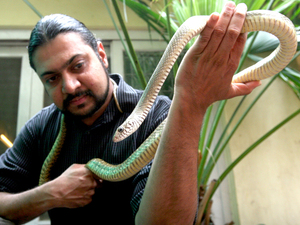 |
| A representative from the animal rescue group "Wildlife SOS" holding a rat snake. |
Some snake rescue groups have developed to attempt to lure some charmers to new occupations like removing venomous snakes from urban areas and returning them to the wild. This has had some appeal to charmers as much of their traditional audience has been lured away in recent years by more modern entertainment.
Wednesday, August 10, 2011
Gandhi: one of India's most respected ideological and political leaders

Like Madonna, Cher, and Elvis, Gandhi is often referred to by a single moniker only, but his full given name was Mohandas Karamchand Gandhi. He hailed from West India, and was born in 1869 - the year the Suez Canal was inagurated, the first game of American college football was played, and the Folies Bergeres opened in Paris.
Gandhi grew up in India, but eventually studied law in London and went on to spend 20 years in South Africa, opposing discriminations against the Indian minority living there.
Gandhi was a pioneer of mass non-violent civil disobedience, known as Satyagraha, and became a major political and spiritual leader in his day. Simplicity was at the core of Gandhi's lifestyle - including making his own clothes, enjoying a vegetarian diet, and taking part in fasting as an act of self-purification and at times, protest.

In his mid 40s, Gandhi returned to India, becoming active in politics, supporting the independence movement (India was still under British rule), and aiming to help the disenfranchised - poor farmers and laborers who suffered under oppressive taxation, those living in poverty, and women. Gandhi stirred up much controversy with his view that the caste system should be put to an end. Gandhi met with much opposition and although his protest was non-violent, spent some time in prison on charges of conspiracy.
"We must be the change we wish to see in the world" - Gandhi
Gandhi attempted to bring peace to the Hindu-Muslim conflict, and was disheartened to see the partition of India in 1947 and ensuing displacement of millions of people as well as the murder of hundreds of thousands in the tumultuous transitional time.
Shortly after - one evening in January of 1948 - Ghandi was approached by a young man, Natharum Godse, while he was in the midst of greeting Namaste to the crowd. Godse bowed his head, pulled a revolver from his pocket, and shot Gandhi three times in the chest.
Gandhi's death did not end his global impact. Innumerable people have been inspired by his non-violent pursuit of peace.
"The best way to find yourself is to lose yourself in the service of others" - Gandhi
Thursday, August 4, 2011
Indian paintings at the San Diego Museum of Art
I went to the San Diego Museum of Art a couple days ago to take my students on a field trip of the Asian Art collection, and while we were there I happened to take in some lovely Indian paintings created by the artists of the courts which were in the present-day state of Rajasthan during the 1700s. The capital was moved from Amber to Jaipur during this time, and the kings were the subjects of the Mughal emperors from 1562 until the British colonized India in 1858. Mughal influence inspired many of the Amber and Jaipur court members to be connoisseurs of the arts, commissioning artists to create illustrated manuscripts and album pages, practices that had been learned from the Persians.  |
| Todi Ragini, India, Rajasthan, Opaque watercolor and gold on paper, ca. 1700 |
Don't think my head is in the gutter though!!! This beautiful painting caught my eye first because of its color palette. I love the mauve landscape forms, that seem to imply movement with the slightly lighter and golden swirling details incorporated, and those sections especially jump out when viewed against the flat, blue-green middle ground. The deer are so elegant, and I love the detailed depiction of foliage.
 |
| Todi Ragini, India, Rajasthan, Amber Court. Opaque watercolor and gold on paper, ca. 1720 |
The poem at the top of the page reads:
She is in meditation like an ascetic.
Every limb of her body is filled with a beautiful intoxication.
Her heart is filled with the pain of separation from her lover.
She is singing at night with her heart filled with the thoughts of her lover,
and these echo in her song.
and these echo in her song.
Surrounded by peacocks, filled with pangs of separation, she drowns herself in music.
 |
| Lord Shiva attended by Parvati, India, Rajashtan, Jaipur court. Opaque watercolor and gold on paper, ca. 1790. |
The main figure are Lord Shiva, a major Hindu diety seen as a creator and destroyer figure, and Parvati, his wife, who is sometimes considered a diving maternal figure. Shiva and Parvati are surrounded by guards, yogis, and their elephant-headed son Ganesha. Shiva appears intoxicated, perhaps by bhang, a beverage derived from cannabis, which is said to be his favorite intoxicant as it keeps the world safe from his anger. Bhang is still sold in India, where it is generally not considered a drug, but instead sleeping aid or appetizer.
Thursday, July 28, 2011
Indian Home Cooking!!!!
I posted a blog the other day about my Indian shopping adventures - now you have a chance to see how my cooking turned out!!!

My mom is a huge fan of Manjula Jain's recipe website - Manjula's Kitchen. Sweet Manjula has created loads of videos to help demystify Indian cooking. Earlier, I looked at a few cookbook recipes with about thirty ingredients and 24 hours+ cooking time and figured I'd just give up on making Indian food this month, but I could actually follow Manjula's simple and straightforward recipes!

Manjula's husband films her in her Rancho Bernardo kitchen and they upload a few new videos every month - she has over a hundred on her website since starting about 4 years ago. Here's a great article from "Voice of San Diego" about Manjula.
For my first attempt at Indian home cooking, I decided to make Aloo Gobi - a main dish made of potatoes, cauliflower and spices....one of my favorites at Indian buffets! Check out the video above to hear Manjula's recipe. Here's how mine turned out:

So, here's my Aloo Gobi with mango and cilantro chutneys (store bought- I cheated!) as well as some whole wheat paratha bread I picked up at Bombay Bazaar, and I had a bit of Khatta Meetha snack mix on the side. Turned out really good!!!!!

Yesterday, I decided to try out even more recipes! What you see here is some rice I made kinda in line with her zucchini rice recipe (minus the zucchini because I didn't have any!), Sambar (spicy lentil soup) and cauliflower pickle. It tasted good last night, but even better as leftovers for lunch today!!!
You should check out Manjula's website!!!!
Wednesday, July 27, 2011
Indian Culinary Adventures
Mmmmmm Indian food! I've had more this month than I've had in a year and that is a good thing (well, maybe not for my waistline, but man has it been delicious!!!). Here's some of my recent culinary adventures.
I hate to use this expression on my blog, but OMG. It was good. Real good. I loooooove Masala Dosas!!!! Basically it is a thin crepe (made from fermented rice crazily enough!) filled, in this case, with a spiced potato mixture and accompanied with various chutneys - cilantro chutney and a few others I didn't recognize (not my favorite part of the meal - the dosa could stand on it's own) and a cup of dal. Altogether a phenomenal lunch, under $7.
Oh man, I bought SOOOOO much at the market! I came with a few recipes in mind, and stocked up on a bunch of spices and specialty ingredients. I got a couple types of bread (whole wheat roti and parathas), mango chutney, cilantro chutney, tamarind paste, curry leaves, a cheapo frozen meal of onion uttapam, toor dal, a snack mix (khatta meetha - a sweet and spicy blend of gram flour noodles, puffed rice, grean peas and peanuts), asafoetida powder (which I refer to only as ASSafoetida powder because it smells so gross), and mustard, fennel, carrow and fenugreek seeds. I also picked up some Nag Champa incense because it reminds me of my friends in PA who always burn it during their band practices:)
Cooking blog to follow!!!!
 |
| Spice Court |
I looked up Indian grocery stores in San Diego and came across a bunch on Black Mountain Road. I know from my time living in Indiana and visiting friends in New Jersey that some of the best Indian food comes from hole-in-the wall restaurants in the midst of strip malls dominated by Indian stores, so I figured it was a good place to check out (note - any Indian strip mall of repute in New Jersey also has a Dunkin Donuts). Spice Court was a small market, with a fair selection of Indian spices and packaged goods as well as a small produce section and a rather plain dining area (the Copper Chimney Restaurant) with a few tables. I checked out the handwritten poster menus on the wall and decided to get one of my favorite Indian foods for lunch - Masala Dosa.
 |
| Masala Dosa from the Copper Chimney |
I hate to use this expression on my blog, but OMG. It was good. Real good. I loooooove Masala Dosas!!!! Basically it is a thin crepe (made from fermented rice crazily enough!) filled, in this case, with a spiced potato mixture and accompanied with various chutneys - cilantro chutney and a few others I didn't recognize (not my favorite part of the meal - the dosa could stand on it's own) and a cup of dal. Altogether a phenomenal lunch, under $7.
 |
| Bombay Bazaar |
Next, I headed across to the larger Indian grocery store, Bombay Bazaar. This place got some bad reviews on Yelp that I don't quite think are fair. It was well stocked, had lots of specialty items, and was fairly well organized, especially compared to some of the other markets I have been to for my armchair traveling food adventures. I found absolutely EVERYTHING on my list and didn't even need to ask for help!
 |
| I was totally amused by the Pillsbury brand naan bread!!!! |
 |
| my haul!!!!!! |
Cooking blog to follow!!!!
Subscribe to:
Posts (Atom)